What Happens to Your Business When Your Receptionist Calls in Sick
When a receptionist calls in sick, trade contractors miss every inbound call — losing emergency service bookings, new customer inquiries, and follow-up calls. The average contractor misses 15–25 calls on a sick day, representing $7,500–$12,500 in lost revenue at a $500 average job value.
TL;DR: When your receptionist calls in sick, every missed call is a missed job. HulloDesk is the only communication system that never gets sick, never takes vacation, and never sends a customer to voicemail — making sick days a staffing issue, not a revenue issue.
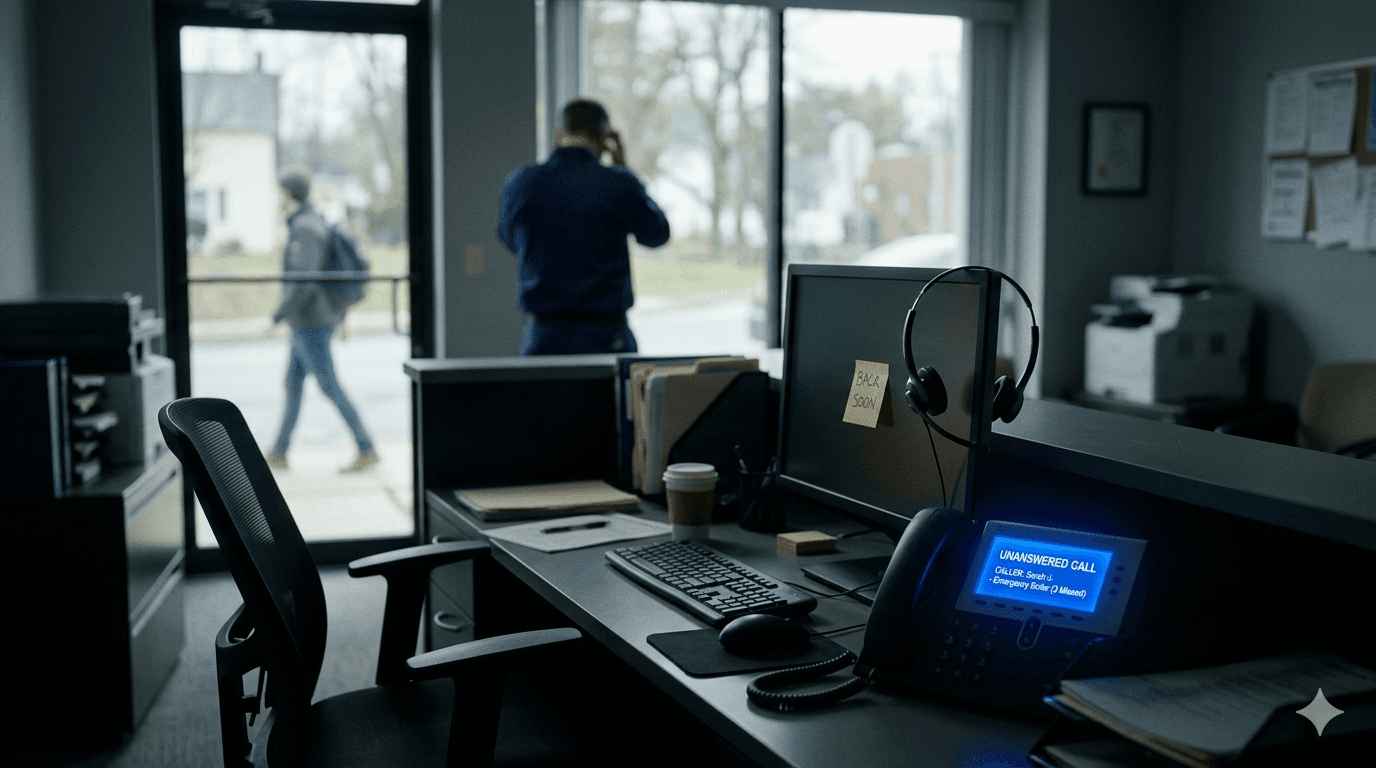
It's 7:52 AM on a Tuesday. Your best CSR texts to say she's sick and won't be in. You have eight techs going out on jobs, 40 to 60 calls expected before noon, and two estimates scheduled for 10 and 11 AM. What happens next is a preview of how dependent your revenue is on a single person being present — and it's a preview that most trades business owners find uncomfortable.
The Realistic Scenario
You forward the main line to your cell phone. By 8:45 AM you've answered three calls between emails and a parts vendor conversation. At 9:10 AM you're in the truck heading to a job and miss four calls in a row. By 10:30 AM you've got seven voicemails and two missed estimate appointments whose callers gave up when no one answered to confirm. By end of day, you've recovered maybe half of the calls that came in. The other half — the ones who hit voicemail during the hour you were unavailable, the ones who called twice and hung up the second time — are already working with a competitor.
This isn't a worst-case scenario. It's a typical sick day for a trades business without a call handling system that operates independently of any individual person's presence.
What Revenue Is Actually at Risk
A single sick day for an office CSR typically costs a busy trades business between $1,500 and $4,000 in missed job opportunities — the calls that went unanswered and the customers who booked elsewhere before the callback arrived. Multiply that by the realistic frequency of single-day absences (sick days, personal days, family emergencies, holidays), and the annualized revenue impact is significant — often exceeding the CSR's entire annual salary.
Most business owners don't calculate this number because missed calls don't appear in any report. The day feels hectic and stressful, but the specific revenue loss is invisible. That invisibility makes it easy to underestimate the structural problem and continue patching it situationally rather than solving it permanently.
The Wrong Solutions Most Contractors Try
The most common patch is forwarding calls to the owner's cell or a technician's cell. This works poorly for several reasons: the person receiving forwarded calls is doing something else (running a job, driving, handling their own calls), the call quality is inconsistent, they can't book into the CRM in real time, and the ongoing burden creates resentment. After a few months, the "backup" starts letting calls go to voicemail anyway.
Hiring part-time backup staff is expensive, creates training overhead, and still leaves gaps when the backup is unavailable. A live answering service is better but introduces the message-vs-booking problem and per-minute billing on high-volume days.
The Permanent Fix
The structural solution is to stop treating call handling as a staffing function. When an AI is the primary system for answering calls — not a backup, not a failsafe, but the default first responder for every inbound call — a sick day becomes a staffing issue rather than a revenue issue. The AI answers every call. The AI books every appointment. The AI sends every confirmation. Staff handles exceptions, escalations, and the human interactions that actually require human judgment.
In this model, a sick day means you're short-staffed for escalations. It doesn't mean you're missing calls. It doesn't mean revenue is leaking while you forward calls to your cell phone between jobs. The phone is answered. The jobs are booked. The day proceeds.
HulloDesk operates as that permanent first responder — 24/7, no sick days, no vacations, no coverage gaps. For $299/month, it handles what would otherwise cost $45,000 per year in CSR salary, every hour of every day, whether your team is fully staffed or not.
Make sick days a staffing issue, not a revenue issue — try HulloDesk free →
How much are missed calls costing you?
Adjust the numbers to match your business.
How to get started
Follow these clear steps to implement this strategy in your business today.
Stop treating call handling as a staffing function
Redesign your call handling so that AI is the primary system and human staff handles exceptions and escalations. This way, no single absence threatens call coverage.
Set up AI as your permanent first responder
Configure HulloDesk to answer every call before it ever rings to a human. The AI handles booking, intake, and triage. Calls requiring human judgment are warm-transferred. Staff absence has no impact on call coverage.
Document your backup protocol once and automate it
Stop solving the sick-day problem reactively every time it happens. Set up a system that makes the problem permanent-solved, not situationally-patched.
Frequently Asked Questions
Q:How many calls does the average trades business miss when a CSR is out?
Q:What is the best backup system for when office staff are unavailable?
Q:Isn't forwarding calls to a team member's cell phone a good enough backup?
The AI Front Office Setup Checklist
Stop losing jobs to missed calls. Get the 4-step checklist we use to set up 24/7 AI receptionists for $1M+ trade businesses.
No spam · Instant PDF delivery · Unsubscribe anytime

Prajwal Kumar is the founder of HulloDesk and an expert in AI voice automation for the trades. He built HulloDesk after watching skilled contractors lose jobs to competitors who simply answered the phone faster. He writes about AI, lead conversion, and practical growth systems for HVAC, plumbing, electrical, and home service businesses.
View all insights by Prajwal