How Much Does an Answering Service Cost for HVAC Companies?
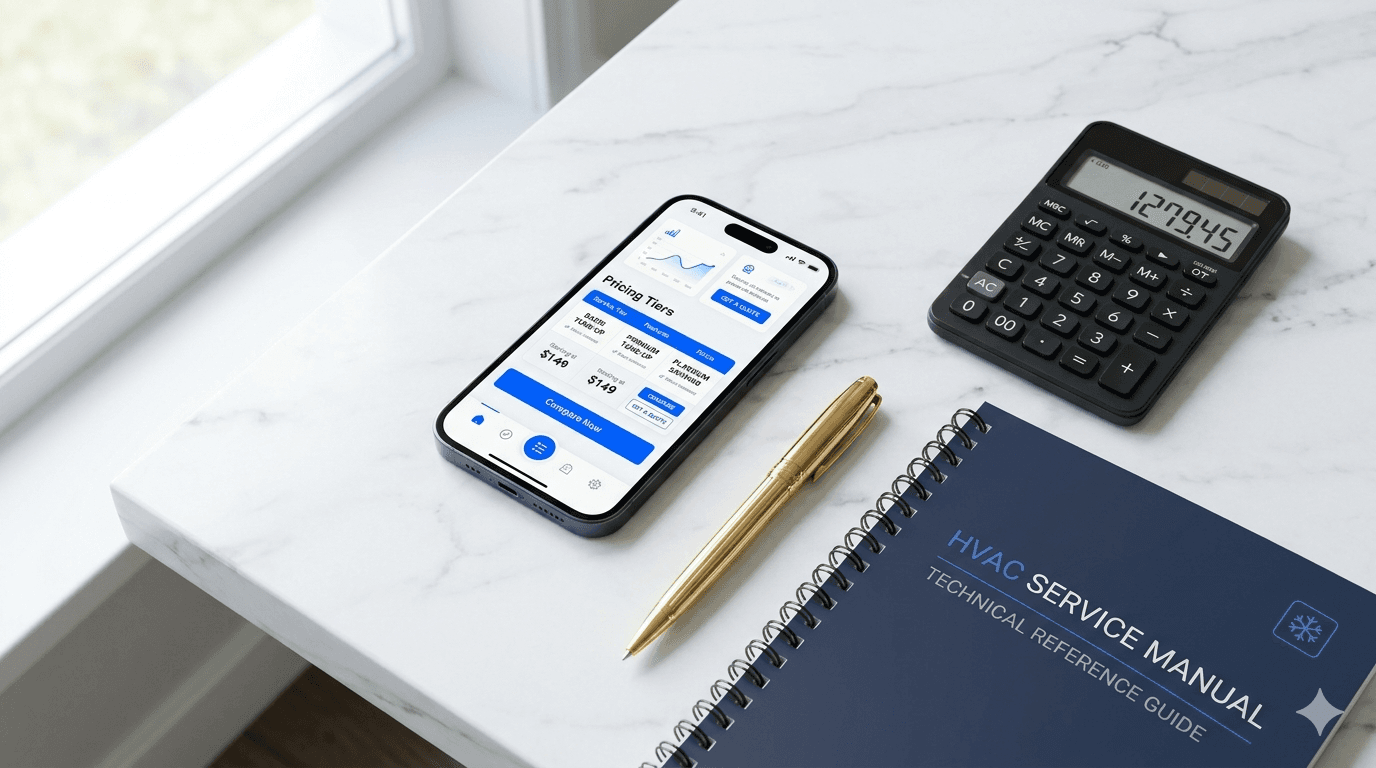
HVAC answering services cost $200–$800+ per month depending on call volume and model. Traditional live answering services charge $235–$500 per month base plus per-minute fees that spike during heat waves. AI answering services like HulloDesk cost $299 per month flat with no per-minute billing and direct CRM integration.
TL;DR: Traditional HVAC answering services cost $200–$500/month and only take messages. HulloDesk books jobs at a flat rate — often paying for itself with a single saved service call. Here's exactly how the pricing models compare.
If you've started researching answering services for your HVAC company, you've probably noticed that pricing is hard to find. Most providers bury their rates behind a "call us for a quote" form. This guide breaks down what HVAC answering services actually cost, what the different billing models mean in practice, and how to figure out which structure makes sense for your business.
The Three Main Pricing Models
Almost every answering service — live or AI — charges using one of three structures:
- Per-minute billing. You pay for every minute spent on a call, typically $0.90 to $1.50 per minute. A 4-minute call costs $3.60 to $6.00. During a busy season when calls run long — homeowners who haven't used their AC in six months asking detailed questions — per-minute costs accumulate fast and are hard to predict.
- Per-call billing. You pay a flat rate per call answered, typically $0.75 to $1.50 per call. Predictable, but still variable with volume. A company that receives 300 calls in July pays significantly more than in March.
- Flat monthly rate. A fixed monthly fee that includes a set number of calls or minutes, with overage charges above the threshold. AI platforms increasingly offer this model with higher base limits, making it the most predictable option for most HVAC businesses.
What You Actually Get at Each Price Point
The cheapest answering services — $50 to $150 per month — typically provide message-taking only. A live operator answers, collects name and phone number, and sends you a text or email. That is the entire service. They don't know your pricing, can't answer technical questions, and have no integration with your scheduling software. Your office still has to make a callback, and by then — especially for after-hours emergency calls — the customer may have already called a competitor.
Mid-tier services at $150 to $350 per month offer slightly more: some can follow a script, collect a bit more intake information, and flag emergencies differently from routine calls. They're still human operators, which means hold times, inconsistent quality, and availability gaps during surge periods.
At the top end — $350 to $800 per month — you get dedicated virtual receptionist services with trained staff. Higher consistency, more customization, and the ability to handle more complex call flows. Still no real-time booking into your CRM, and still subject to all the unpredictability of human staffing.
The Hidden Cost Most HVAC Owners Miss
Every answering service comparison focuses on the monthly fee. But the most important number is what happens after the call. An answering service that takes a message and costs $200 per month produces a stack of messages that someone on your team has to work through and call back. A percentage of those callbacks will go to voicemail. A percentage of those customers will have already booked with a competitor.
An AI-based answering service that books the job directly — integrating with Housecall Pro, ServiceTitan, or Google Calendar — eliminates the callback loop entirely. The customer calls, the AI answers, the job is scheduled, the confirmation goes to the customer by SMS, and the appointment appears in your system. No callback required. No message-to-booking conversion loss.
When you're evaluating cost, the right question isn't "how much does the service charge?" It's "how much revenue does each approach actually convert?"
What HulloDesk Costs for HVAC
HulloDesk offers three flat-rate plans starting at $299 per month with a $2.99 / 14-day trial. There are no per-minute fees, no per-call fees, and no setup charges. Every plan includes 24/7 call answering, direct CRM booking, SMS follow-up, and a dedicated business phone number. The AI knows your service area, your pricing, your scheduling availability, and your emergency protocols — and it books jobs without sending a message that someone has to manually follow up on.
If your average HVAC job is worth $350 and you're currently missing 15 calls per month to voicemail, that's $5,250 in monthly revenue you're not capturing. An answering service that takes messages gets you some of those callbacks — maybe. An AI that books the job directly gets you nearly all of them.
How to get started
Follow these clear steps to implement this strategy in your business today.
List your average monthly call volume
Count how many inbound calls you receive per month. This determines whether a per-call, per-minute, or flat-rate plan is more cost-effective for your business.
Calculate your cost per missed call
Take your average job value and multiply it by your estimated missed call rate. Most HVAC businesses miss 20–35% of calls when relying on voicemail or a manual process. This is the true cost you're comparing against.
Compare booking capability, not just call handling
An answering service that takes a message costs $200/month. An AI that books the job costs $299/month. Evaluate what each one actually delivers — a message or a booked appointment.
Frequently Asked Questions
Q:What is the average monthly cost of an answering service for an HVAC company?
Q:What is per-minute billing and why does it matter?
Q:Do answering services actually book HVAC jobs or just take messages?
Q:Are there setup fees?
The AI Front Office Setup Checklist
Stop losing jobs to missed calls. Get the 4-step checklist we use to set up 24/7 AI receptionists for $1M+ trade businesses.
No spam · Instant PDF delivery · Unsubscribe anytime

Prajwal Kumar is the founder of HulloDesk and an expert in AI voice automation for the trades. He built HulloDesk after watching skilled contractors lose jobs to competitors who simply answered the phone faster. He writes about AI, lead conversion, and practical growth systems for HVAC, plumbing, electrical, and home service businesses.
View all insights by Prajwal